When someone’s called a fascist in a political debate or on social media, it’s usually meant as an insult. But few people actually understand what the term truly means, where it came from, or how it’s evolved.
The word fascist doesn’t just describe a harsh or controlling person—it defines a complete political ideology with deep historical roots and devastating real-world consequences.
This in-depth guide explores what fascist really means, its origins, its defining traits, and how it’s used (and misused) in modern times.
What Does “Fascist” Mean?
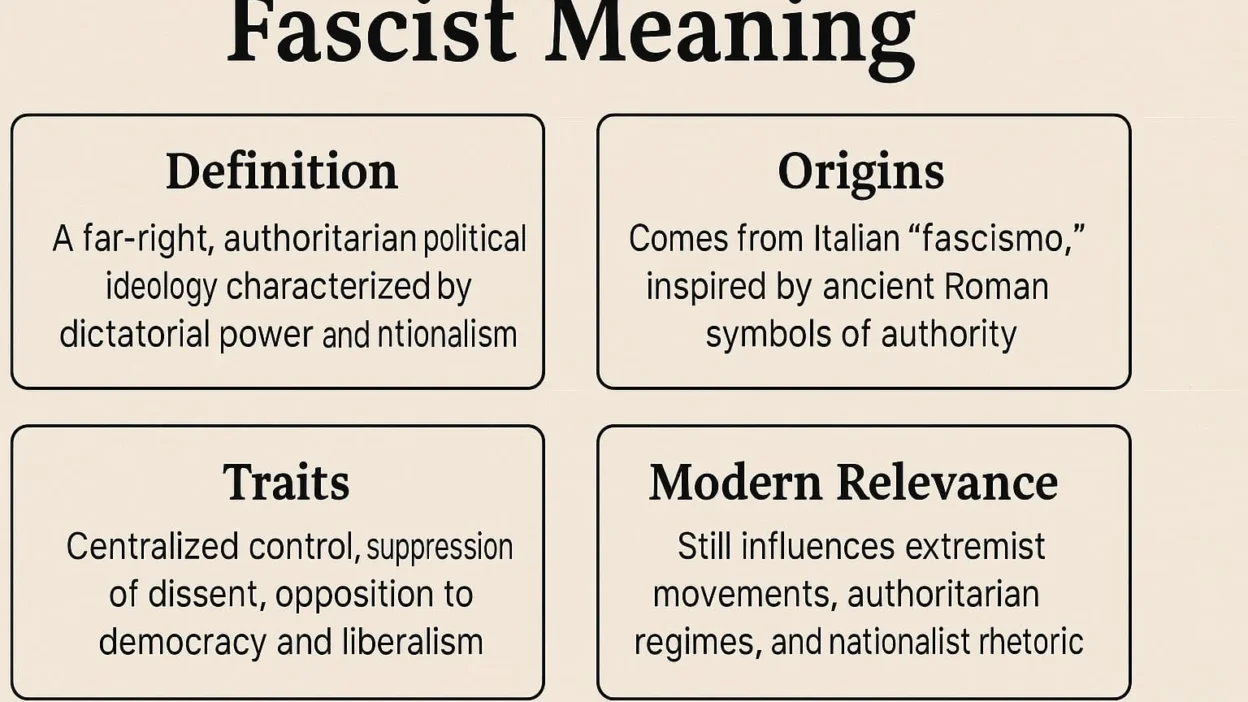
A fascist is someone who supports or enforces a form of fascism—a far-right, authoritarian political ideology that exalts the nation above the individual, demands total loyalty to the state, and suppresses opposition. Fascism promotes a centralized, dictatorial government led by a powerful ruler and often glorifies war, discipline, and national rebirth.
In short:
Fascism = Authoritarian nationalism + total control + suppression of dissent.
Etymology and Origins of Fascism
The word fascist comes from the Italian word fascio, meaning “bundle” or “group.” In ancient Rome, a fasces—a bundle of rods tied around an axe—symbolized power and unity. Early 20th-century Italian nationalists adopted this image to express the idea that strength comes through unity and obedience.
In 1919, Benito Mussolini founded the Fasci Italiani di Combattimento, which later became Italy’s Fascist Party. Mussolini’s fascism rejected democracy and socialism. Instead, it promised a “new order” of national unity, state control, and military strength.
By 1922, Mussolini had seized power and created the first fascist state in history. His movement inspired similar regimes in Germany, Spain, and other parts of the world.
Key Characteristics of Fascism
While fascism varies across countries, most fascist movements share several defining features.
| Core Feature | Explanation |
|---|---|
| Authoritarian Leadership | Power is centralized under one leader or ruling elite who claims to represent the nation’s will. Dissent is silenced through intimidation or violence. |
| Extreme Nationalism | The nation or race is viewed as supreme. Fascists glorify a mythic past and promise a return to former greatness. |
| Militarism and Violence | War and conflict are praised as ways to unite and strengthen the nation. |
| Anti-Democratic Ideology | Fascists reject democracy and pluralism, seeing them as weak or divisive. They prefer one-party rule. |
| Control of Media and Culture | Propaganda replaces free journalism. Art, education, and media serve the state’s agenda. |
| Corporatist Economy | Private property exists, but businesses and workers must serve the state’s goals. The government controls economic sectors through corporations or syndicates. |
| Cult of the Leader | The leader is worshipped as heroic, infallible, and the embodiment of the nation’s spirit. |
| Suppression of Opposition | Political rivals, minorities, and independent thinkers are silenced, imprisoned, or eliminated. |
Historical Examples of Fascist Regimes
1. Italy under Benito Mussolini (1922–1943)
Mussolini’s Italy pioneered fascism as a system. He banned political parties, censored media, and ruled through terror and propaganda. His slogan “Mussolini is always right” captured the cult-like devotion he demanded.
2. Nazi Germany under Adolf Hitler (1933–1945)
Although Nazism had unique racial doctrines, it shared fascism’s foundations: absolute power, ultranationalism, and suppression of freedom. Hitler’s regime added a genocidal racial ideology, leading to the Holocaust and World War II.
3. Francoist Spain (1939–1975)
General Francisco Franco established a fascist-style dictatorship marked by strict censorship, suppression of opposition, and nationalism fused with Catholic traditionalism.
Fascism vs. Other Political Systems
Fascism often gets confused with authoritarianism or totalitarianism. Here’s how it differs:
| Feature | Fascism | Authoritarianism | Totalitarianism |
|---|---|---|---|
| Ideology | National rebirth, unity, and militarism | Power for stability | Complete control over life |
| Public Participation | Mass mobilization, propaganda | Limited participation | Compulsory obedience |
| Economic System | State-guided corporatism | Mixed or state-controlled | Fully state-owned |
| Use of Violence | Glorified and institutionalized | Used for control | Constantly used for fear |
| Example | Mussolini’s Italy | Military juntas | Stalin’s USSR |
Fascism isn’t just about control—it’s about reshaping society around a mythic national ideal and demanding emotional loyalty to the state.
Warning Signs of Fascist Tendencies
Fascism doesn’t always emerge overnight. It creeps in through political culture, propaganda, and public fear. Here are warning signs that mirror fascist behavior:
- Demonizing minorities or outsiders
- Discrediting the press, courts, or democratic institutions
- Obsessive nationalism or “purity” campaigns
- Encouraging violence against critics
- Glorifying a single leader or party
- Using “law and order” rhetoric to justify repression
- Portraying dissent as treason
Recognizing these patterns early helps societies guard against democratic erosion.
Modern Usage and Misuse of “Fascist”
Today, fascist is used far beyond its original meaning. It often appears as a political insult against any authority seen as oppressive. This overuse can blur its true definition.
Legitimate Uses
- Describing regimes or movements with clear fascist features—dictatorship, nationalism, propaganda, and intolerance.
- Analyzing “neo-fascist” groups that revive old fascist ideas in modern forms.
Misuses
- Using “fascist” to describe anyone with strict opinions, conservative views, or harsh policies.
- Labeling political opponents without factual basis.
The term carries historical weight. Misusing it weakens the ability to identify genuine fascist movements when they appear.
Fascism in the 21st Century
While classic fascist regimes collapsed in the mid-20th century, elements of fascist ideology still resurface. In the modern era, neo-fascist and far-right movements use nationalist rhetoric, scapegoating, and digital propaganda to spread old ideas in new ways.
Common modern echoes include:
- Political leaders attacking media and courts
- Populist movements promoting xenophobia
- Online communities glorifying past dictators
- Efforts to rewrite history or deny atrocities
Fascism’s modern forms are more subtle—they use democracy’s own tools (elections, media, nationalism) to weaken democracy from within.
Frequently Asked Questions
1. What is the simple meaning of fascist?
A fascist is someone who supports an authoritarian system that prioritizes national unity, obedience, and control over freedom and diversity.
2. Who started fascism?
Benito Mussolini founded the first fascist movement in Italy after World War I.
3. How is fascism different from dictatorship?
A dictatorship may rule by force without ideology. Fascism combines dictatorship with an intense ideology centered on nationalism, loyalty, and a mythic national mission.
4. Can fascism exist in democracies?
Yes. Fascist tendencies can grow inside democracies when leaders erode institutions, demonize opponents, and promote extreme nationalism.
5. Is fascism left or right-wing?
Historically, fascism is considered far-right because it rejects equality, promotes hierarchy, and glorifies nationalism and traditionalism.
Why Understanding “Fascist” Still Matters
Studying fascism isn’t about the past—it’s about understanding power, fear, and manipulation. Every generation faces movements that test the limits of democracy and freedom. Knowing how fascism operates helps citizens recognize when democracy begins to slip.
Fascism thrives when people trade freedom for security, silence criticism for loyalty, and mistake obedience for patriotism. Recognizing that pattern is the best way to prevent it from repeating.
Conclusion
The term fascist describes much more than an insult—it defines one of history’s most destructive political ideologies. Born in post–World War I Italy, fascism combined authoritarian power, nationalism, and propaganda to create total state control. Its legacy remains a stark warning about how easily fear and pride can destroy freedom.
In today’s world, the echoes of fascism appear in new forms—through digital propaganda, populist nationalism, and attacks on democratic values. Understanding what “fascist” truly means helps us defend liberty, respect diversity, and recognize danger before it takes hold.

Robat Hood is a creative writer and contributor at Saypadia, focused on explaining trending words, slang, and cultural phrases in a simple and engaging way. With a sharp eye for modern language trends, Robat aims to make Saypadia a trusted place for understanding how words are used online and in daily conversations. His content is informative, approachable, and designed for readers of all levels.